The growth of e-commerce over the last decade has been nothing short of remarkable. Online shopping has changed how people buy products, compare prices, and interact with brands. With global e-commerce sales continuing to grow every year, having an online store is no longer optional for modern entrepreneurs—it is a powerful opportunity.
Traditional retail businesses that failed to adapt to the digital shift struggled to survive, while online-first brands and e-commerce platforms scaled rapidly. This shift has encouraged many aspiring entrepreneurs to skip physical stores entirely and start selling products or services directly through an e-commerce business.
Whether you want to sell physical products, digital goods, or services, starting an e-commerce business allows you to reach customers beyond geographical limits and build a scalable business model. However, success in e-commerce requires more than just launching a website. It requires planning, research, branding, marketing, and continuous optimization.
This guide explains what e-commerce is, the different types of e-commerce businesses, and a clear step-by-step process to help you start and grow a successful online store.
What Is E-commerce?
E-commerce, short for electronic commerce, refers to buying and selling goods or services over the internet. Transactions take place through websites, online marketplaces, or mobile apps, allowing customers to shop anytime and from anywhere.
E-commerce includes various business models, such as businesses selling directly to consumers, companies selling to other companies, and even individuals selling products to other individuals online. With advancements in mobile technology and digital payments, e-commerce has become faster, more secure, and more accessible than ever.
Today, a large percentage of online shoppers use mobile devices, making mobile-friendly e-commerce websites essential for success.
Different Types of E-commerce Business Models
E-commerce may seem simple on the surface, but there are several business models operating within this space. Choosing the right model is one of the first steps in starting your e-commerce journey.
Business-to-Business (B2B)
In a B2B e-commerce model, businesses sell products or services to other businesses. This often includes software platforms, tools, and subscriptions that help companies manage operations, payments, or workflows. B2B e-commerce focuses on long-term contracts, bulk orders, and recurring revenue.
Business-to-Consumer (B2C)
This is the most common and widely recognized e-commerce model. Businesses sell products or services directly to individual consumers through their websites or online marketplaces. B2C e-commerce includes physical products, digital subscriptions, and online services.
Consumer-to-Business (C2B)
In the C2B model, individuals sell products or services to businesses. Freelancers, consultants, photographers, and content creators often operate under this model by offering their skills or digital assets to companies.
Direct-to-Consumer (D2C)
D2C businesses design, create, and sell products directly to customers without relying on third-party retailers or marketplaces. This model allows businesses to control branding, pricing, and customer relationships while reducing dependency on intermediaries.
Consumer-to-Consumer (C2C)
C2C e-commerce involves individuals selling products to other individuals through online marketplaces. Handmade products, second-hand items, digital assets, and lifestyle businesses often operate using this model.
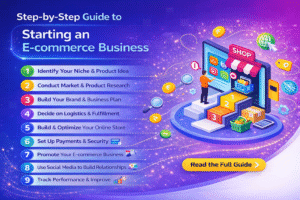
Step-by-Step Guide to Starting an E-commerce Business
Starting an e-commerce business may feel overwhelming at first, but breaking it down into clear steps makes the process manageable.
Step 1: Identify Your Niche and Product Idea
Every successful e-commerce business starts with a clear idea. You need to decide what you want to sell and who you want to sell it to. A niche-focused approach works better than trying to sell everything.
Think about problems people face, gaps in the market, or products that improve daily life. Passion is important, but demand matters more. A good e-commerce product has a defined audience, clear value, and the potential for repeat purchases.
Step 2: Conduct Market and Product Research
Before investing money or time, research your market thoroughly. Market research helps you understand demand, competition, pricing expectations, and customer behavior.
Use tools like trend analysis platforms, keyword research tools, and competitor analysis to understand how people search for similar products. Look at customer reviews on competitor websites to identify common complaints or unmet needs.
Product research reduces risk and increases your chances of launching a profitable e-commerce business.
Step 3: Build Your Brand and Business Plan
A business plan provides direction and clarity. It outlines your goals, target audience, pricing strategy, marketing approach, and estimated costs.
Branding is equally important. Your brand name, logo, messaging, and tone should be consistent and memorable. Choose a brand name that is easy to remember and available as a domain name to avoid complications later.
Strong branding builds trust and helps customers recognize your business across platforms.
Step 4: Decide on Logistics and Fulfillment
How you deliver products to customers is a critical part of e-commerce operations. Your logistics strategy depends on the type of product you sell.
If you sell digital products, delivery is instant, and there are no shipping costs. If you sell physical products, you need to plan inventory storage, packaging, shipping costs, and delivery timelines.
Dropshipping is another option where suppliers handle storage and shipping, allowing you to focus on marketing and customer experience.
Step 5: Build and Optimize Your E-commerce Website
Your e-commerce website is the heart of your online business. It should be easy to use, visually appealing, fast, and secure.
Product pages should include clear images, detailed descriptions, pricing, and strong calls to action. Navigation should be simple, and the checkout process should be smooth with minimal steps.
A well-designed website improves user experience and increases conversion rates.
Step 6: Set Up Payments and Security
Customers expect safe and flexible payment options. Your e-commerce store should support popular payment methods and display security measures clearly.
Transparent return policies, contact details, and secure checkout systems build trust and reduce hesitation during purchase decisions.
Step 7: Promote Your E-commerce Business
Marketing is what brings visitors to your online store. Without marketing, even the best products may not sell.
Search engine optimization helps your store appear in organic search results. Social media marketing builds awareness and engagement. Paid advertising can drive faster traffic, while email marketing helps convert and retain customers.
A balanced digital marketing strategy ensures consistent growth.
Step 8: Use Social Media to Build Relationships
Social media is a powerful tool for e-commerce businesses. It allows you to connect with your audience, showcase products, and build a loyal community.
Focus on platforms where your audience is active. Share valuable content, behind-the-scenes updates, product demos, and customer stories. Consistency and engagement are more important than posting frequently.
Step 9: Track Performance and Improve
Data is essential for growth. Track website traffic, conversion rates, bounce rates, mobile performance, and customer behavior.
Analytics help you understand what works and what needs improvement. Regular optimization based on data leads to better user experience and higher sales.
Step 10: Create Consistent Content Marketing
Content marketing builds trust and authority. Blogs, videos, and social content help educate customers and keep them engaged.
Consistency is key. Regular content keeps your brand visible and supports SEO efforts. Every piece of content should guide users toward taking action, whether that’s making a purchase or signing up for updates.
Final Thoughts
E-commerce is no longer just a trend—it is a permanent part of how people shop and do business. Starting an e-commerce business offers flexibility, scalability, and access to a global audience.
Success requires patience, strategy, and adaptability. By choosing the right niche, building a strong brand, focusing on user experience, and using smart digital marketing strategies, you can build a successful and sustainable e-commerce business.
The opportunity is real. With the right foundation and consistent effort, your e-commerce business can grow into a strong and profitable online brand.
How AI Digitech Helps Grow Your E-commerce Business
AI Digitech helps e-commerce businesses grow by improving online visibility, driving targeted traffic, and increasing conversions. We optimize e-commerce websites for search engines, create SEO-friendly product and content strategies, and run data-driven digital marketing campaigns to attract high-intent buyers. From improving website performance and user experience to building brand trust and customer retention, our strategies are designed to scale your e-commerce business sustainably and profitably.